Haemodynamic and renal effects of a novel prostaglandin analogue (L644,122 (+isomer) ) in sheep
Tresham, J.J.; Whitworth, J.A.; Scoggins, B.A.
Clinical and Experimental Pharmacology and Physiology 14(10): 779-784
1987
ISSN/ISBN: 0305-1870 PMID: 3327638 DOI: 10.1111/j.1440-1681.1987.tb01868.x
Accession: 040243567
Full-Text Article emailed within 0-6 h
Payments are secure & encrypted


Summary
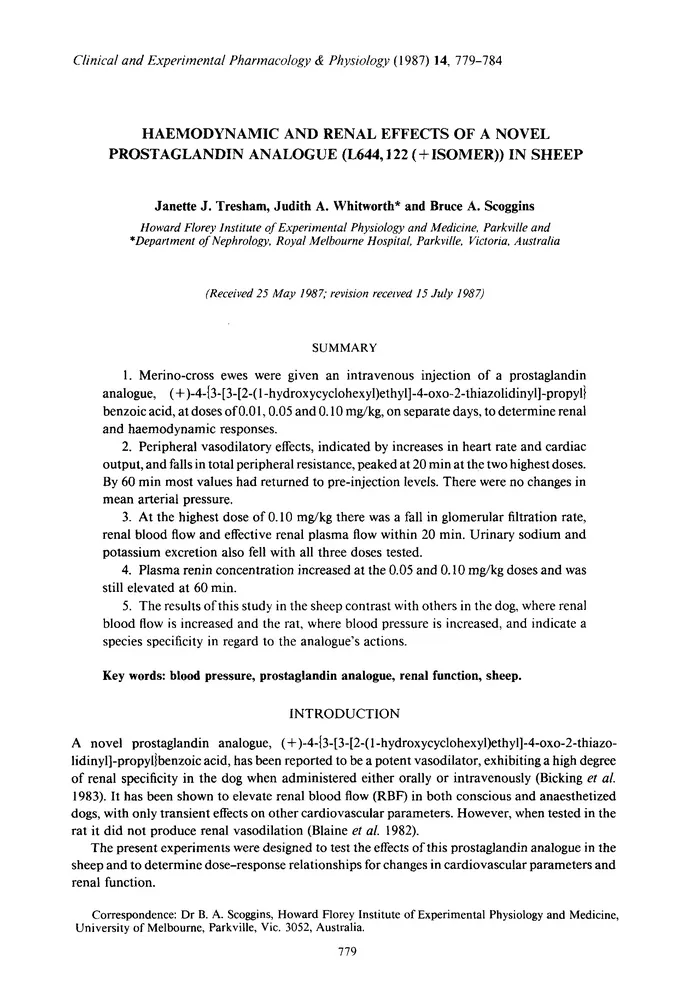
1. Merino-cross ewes were given an intravenous injection of a prostaglandin analogue, (+)-4-(3-[3-[2-(1-hydroxycyclohexyl)ethyl]-4-oxo-2-thiazolidinyl]- propyl) benzoic acid, at doses of 0.01, 0.05 and 0.10 mg/kg, on separate days, to determine renal and haemodynamic responses. 2. Peripheral vasodilatory effects, indicated by increases in heart rate and cardiac output, and falls in total peripheral resistance, peaked at 20 min at the two highest doses. By 60 min most values had returned to pre-injection levels. There were no changes in mean arterial pressure. 3. At the highest dose of 0.10 mg/kg there was a fall in glomerular filtration rate, renal blood flow and effective renal plasma flow within 20 min. Urinary sodium and potassium excretion also fell with all three doses tested. 4. Plasma renin concentration increased at the 0.05 and 0.10 mg/kg doses and was still elevated at 60 min. 5. The results of this study in the sheep contrast with others in the dog, where renal blood flow is increased and the rat, where blood pressure is increased, and indicate a species specificity in regard to the analogue's actions.